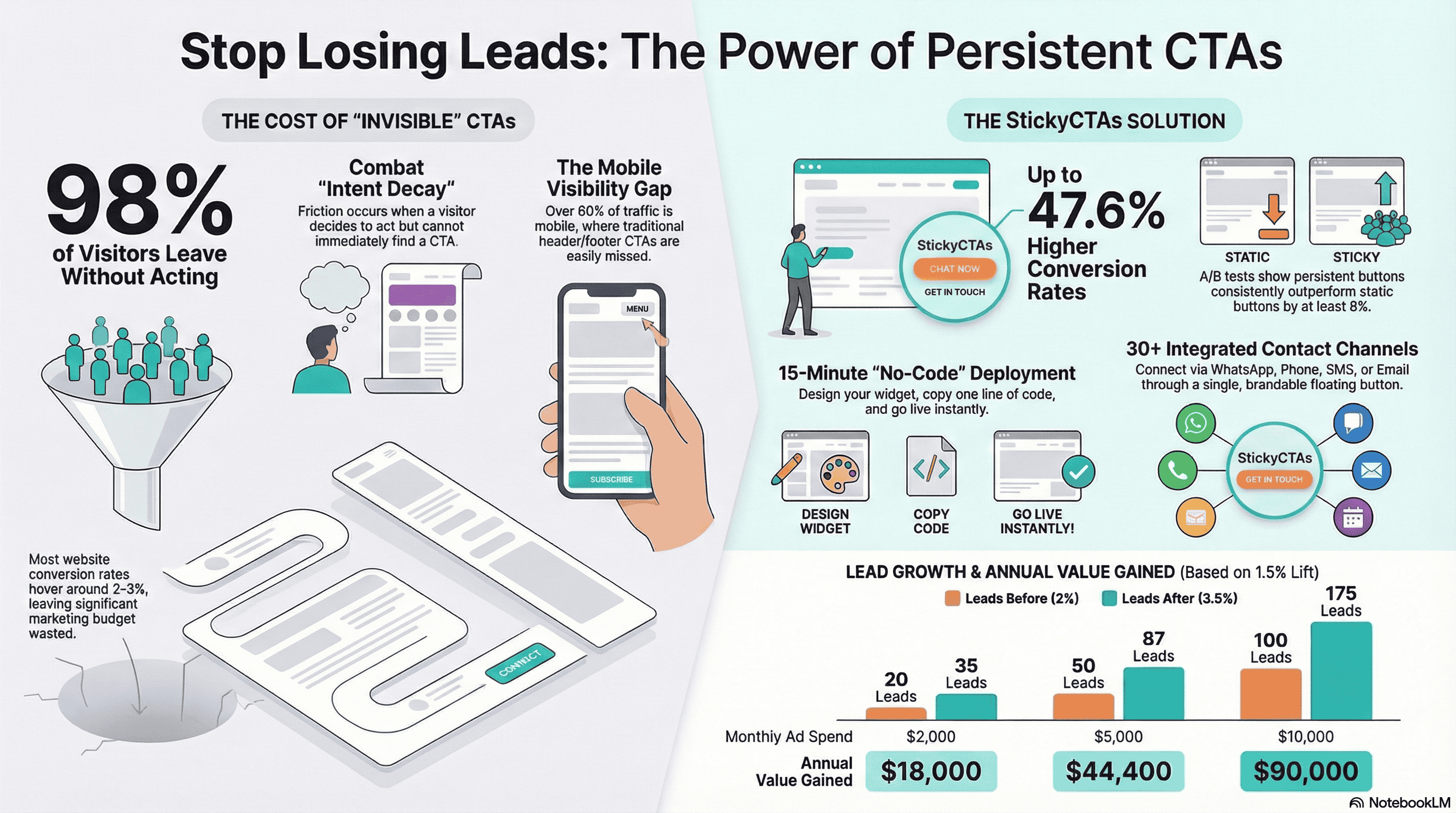
The average website conversion rate sits at a sobering 2–3%. This means that for every 100 visitors you pay to acquire through SEO or paid search, roughly 98 evaporate before taking action. This “leaking bucket” represents the single largest hidden cost in digital marketing: the financial penalty of the invisible call-to-action.
When contact information is buried in a footer or hidden behind several scrolls, you aren’t just losing a lead — you are watching your Customer Acquisition Cost (CAC) skyrocket in real time. Recovering these lost conversions doesn’t require a larger ad budget. It requires eliminating the friction that kills a sale in the final five seconds of a visit.
The Psychology of Intent Decay and Cognitive Load
Traditional CTAs often fail because they ignore the reality of “intent decay” — the rapid drop-off that occurs between the moment a visitor decides to act and the moment they actually locate a way to do so. In a high-distraction digital environment, a five-second delay is all it takes for a Slack notification or a tab switch to sever the connection.
The problem is rarely the quality of your traffic; it is the friction between visitor intent and action. By ensuring the next step is always visible, you eliminate the cognitive load required to “find” the contact info. You stop forcing the visitor to work for the privilege of becoming a lead.
“The key to a powerful call to action is to provide consumers with compelling reasons to purchase promptly rather than defer purchase decisions.”
Matching Preferred Communication Styles
Modern users do not follow a uniform path to conversion — they have distinct “channel-specific friction.” Some visitors will never fill out a static form but will eagerly send a WhatsApp message. Others ignore phone numbers but prefer direct booking links or SMS.
By offering a menu of 30+ channels — ranging from WhatsApp and Messenger to job boards and booking links — you match the visitor’s preferred communication style. This psychological alignment is why offering choice, rather than a single “Contact Us” form, can increase lead generation by 3x to 5x. It treats the CTA not as a demand, but as a concierge service.
The Data: From “Modest” Gains to 47% Lifts
The impact of persistent visibility is quantifiable through a shift in Revenue Per Visitor (RPV). In one rigorous A/B test, a sticky CTA drove significant improvements across every key metric:
+47.6%
Conversion rate
+48.3%
Revenue per visitor
+8%
Minimum floor across all variants
While the floor for these improvements is a statistically significant 8% win, even “modest” mobile-first gains of 2.74% can fundamentally alter a company’s bottom line. Intellectual honesty requires acknowledging that results vary by industry — but across every variation tested by leading CRO agencies, sticky elements consistently outperformed static controls. It is the difference between a visitor “considering” an action and “executing” it the moment they feel the impulse.
Mobile Success and the Credibility of Millimeters
Mobile conversion is a matter of physical reality and thumb-based interaction. Most mobile CTAs fail because they are too small or positioned outside the “thumb-zone,” forcing users to shift their grip. Adhering to the 48×48px touch target — the standard recommended by Google and WCAG 2.2 — is more than a technical requirement; it is a credibility signal.
When a mobile interface uses a full-screen menu drawer and properly sized targets, the site feels custom-built and authoritative. This precision builds brand trust. In a world of clunky popups, a polished, accessible mobile CTA tells the user that your business is as professional as your digital presence suggests.
The Performance Paradox: A Privacy-First Unicorn
A common fear is that adding widgets will degrade page speed and Lighthouse scores. However, a well-engineered persistent CTA is a unicorn in marketing tech: a 6.5 KB gzipped script that loads asynchronously with zero impact on Core Web Vitals.
Furthermore, this efficiency extends to compliance. By operating without cookies, tracking pixels, or the collection of PII, these tools are future-proofed for GDPR and CCPA. They provide a high-conversion environment without the legal or performance “tax” associated with traditional tracking scripts. Installation is a single line:
<script src="https://www.stickyctas.com/widget.js" data-widget-id="YOUR_WIDGET_ID" async></script>Found Revenue: The Economics of Reduced Friction
Optimizing for the final five seconds of a user’s visit is a “found revenue” exercise. If you can lift a conversion rate from 2% to 3.5% through persistent visibility, your Cost Per Lead (CPL) drops from $100 to $57. For an established business spending $10,000/month on ads, this represents an equivalent annual value of $90,000 — revenue recovered without spending an additional dollar on traffic.
The math is straightforward:
- $2,000/mo ad spend → 20 leads before, 35 leads after → $18,000 annual value gained
- $5,000/mo ad spend → 50 leads before, 87 leads after → $44,400 annual value gained
- $10,000/mo ad spend → 100 leads before, 175 leads after → $90,000 annual value gained
Based on a 1.5% conversion lift from 2% to 3.5%.
If your traffic stays flat, how much of your current ad spend is being wasted on the friction of finding a “Contact” button? Every second a visitor spends searching is a second they spend reconsidering. How many leads did you lose today to those final five seconds?
Key Takeaways
Intent decay is the gap between a visitor’s decision to act and their ability to find the CTA — a persistent widget closes it instantly.
Offering 30+ contact channels matches visitors’ preferred communication styles and eliminates channel-specific friction.
A/B tests consistently show 8%–47% conversion lifts — even modest mobile gains of 2.74% compound into significant annual revenue.
A well-built persistent CTA is privacy-first, cookie-free, and adds zero render-blocking weight — no performance or compliance trade-off required.
Stop losing leads to the final five seconds.
Deploy a persistent CTA in under 15 minutes and start recovering the conversions already in your traffic — no extra ad spend required.
Start Free Trial